

Technology that helps older people create art to stay active longer
Home > Projects > Technologie die ouderen helpt bij het maken van kunst om langer vitaal te blijven
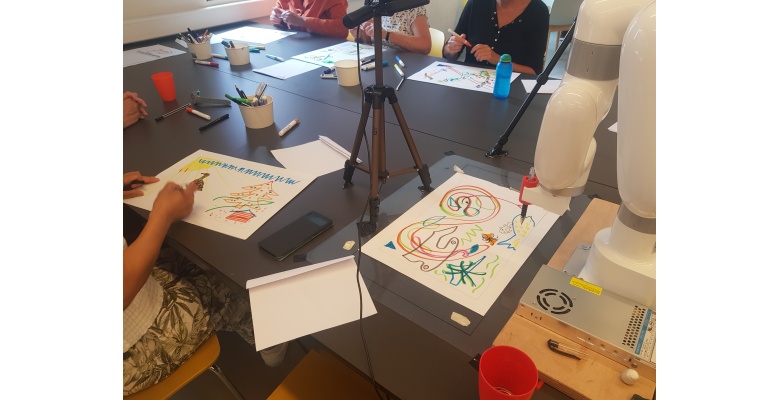
Technology that supports older adults in creative activities
Research has shown that creative activities contribute to well-being, vitality and healthy aging. Robots and Artificial Intelligence (AI) offer unique opportunities for creative collaboration with humans. Robots are already being used to support the elderly, but rarely for creativity support. Therefore, there are unanswered questions about how the technology can help older people in creative activities.
Marianne Bossema, researcher at Digital Life, will investigate this during her PhD with a focus on collaborative drawing and painting. Starting point is that the technology should be developed to support and enrich, rather than to replace human creativity. Meaningful human social interaction remains essential to the well-being and satisfaction of older people in creative activities. With that in mind, we investigate together with end users, artists, and students how technology can be of added value for the creative experiences of older adults.
Social robots
A social robot is designed to communicate with humans, and to attune to human social interaction. Some social robots have a humanoid shape, others don’t. Characteristic is the social interaction in a way that’s natural and intuitive for humans. Social robots can assist, for example by giving advice, helping with tasks, or simply being a friendly companion. Through interaction and adaptation, a social robot can learn to understand situations and people. This way the robot can learn to be a co-creative partner, for example through drawing interactions with humans.
Collaborative drawing
A social robot offers opportunities to support the elderly in creative activities such as drawing. For example, the robot can inspire by generating ideas. Through conversations and interactions, the robot can introduce topics and techniques that foster creativity. The robot can also guide, giving step-by-step instructions or demonstrate drawing skills and techniques. The robot can give verbal and nonverbal feedback, e.g. by reacting to drawings, and making suggestions to improve or supplement the work. Collaborating with a robot can contribute to an interactive and stimulating environment. Reflection is also an important part of the creative process, which the robot could help with. In addition, the robot can offer a sense of companionship, to support elderly during their creative process.
Based on drawings made, an AI system can make suggestions. It can generate and display images, for example on a screen or projected on drawings. The user can select a proposal or request new suggestions in a dialogue with the robot. A suggestion could also be assigned to the robot, a command for the robot to draw. Such a dialogue in words and images offers opportunities for support in various phases of the creative process.
Creative dialogues
The aforementioned possibilities have not yet been fully explored. The aim of this PhD research is to investigate this together with users, artists and students. We will develop prototypes that help to explore what and how the technology can contribute. The central idea for prototypes and experiments is to elicit and support creative dialogues through improvisation and play. These dialogues will be designed and evaluated, which provides insight into how an embodied intelligent agent can a) learn to understand and adapt to human creative behaviors, and b) introduce novel affordances from its own non-human perspective. Ultimately, the goal is to support creative experiences of older adults, and thereby contribute to vitality and healthy aging.